Class: AP1 | Unit: Unit 6 | Updated: 2026-02-09
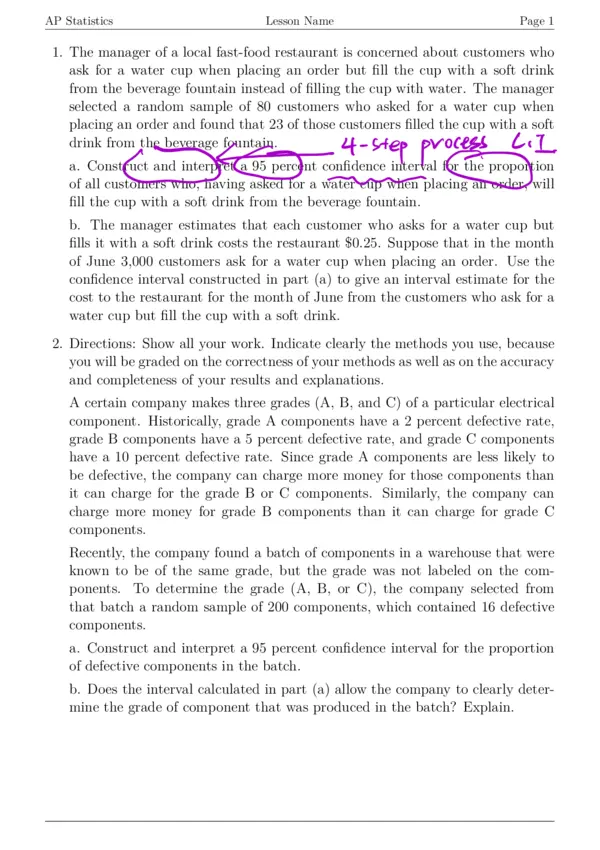
AP Statistics Lesson Name Page 1 1. The manager of a local fast-food restaurant is concerned about customers who ask for a water cup when placing an order but fill the cup with a soft drink from the beverage fountain instead of filling the cup with water. The manager selected a random sample of 80 customers who asked for a water cup when placing an order and found that 23 of those customers filled the cup with a soft drink from the beverage fountain. 4-step process L.I. a. Construct and interpret a 95 percent confidence interval for the proportion of all customers who, having asked for a water cup when placing an order, will fill the cup with a soft drink from the beverage fountain. b. The manager estimates that each customer who asks for a water cup but fills it with a soft drink costs the restaurant $0.25. Suppose that in the month of June 3,000 customers ask for a water cup when placing an order. Use the confidence interval constructed in part (a) to give an interval estimate for the cost to the restaurant for the month of June from the customers who ask for a water cup but fill the cup with a soft drink. 2. Directions: Show all your work. Indicate clearly the methods you use, because you will be graded on the correctness of your methods as well as on the accuracy and completeness of your results and explanations. A certain company makes three grades (A, B, and C) of a particular electrical component. Historically, grade A components have a 2 percent defective rate, grade B components have a 5 percent defective rate, and grade C components have a 10 percent defective rate. Since grade A components are less likely to be defective, the company can charge more money for those components than it can charge for the grade B or C components. Similarly, the company can charge more money for grade B components than it can charge for grade C components. Recently, the company found a batch of components in a warehouse that were known to be of the same grade, but the grade was not labeled on the com-ponents. To determine the grade (A, B, or C), the company selected from that batch a random sample of 200 components, which contained 16 defective components. a. Construct and interpret a 95 percent confidence interval for the proportion of defective components in the batch. b. Does the interval calculated in part (a) allow the company to clearly deter-mine the grade of component that was produced in the batch? Explain. State.:(1)说要干什么。(2)定义变量。(3)写清细节. (1) We are constructing a confidence interval for P. (2) where p is the proportion of all customers who, having asked for a water cup when placing an order, will fill the cup with a soft drink from the beverage fountain. (3). at 95% confidence level. Plan. (1)什么方法。(2)验证条件. (1). We are using 1-sample z-interval for P. if all conditions are met (2). 1) SRS the sample of 80 customers was randomly selected. 2). 10% condition It is reasonable to assume that the sample of 80 customers is less than 10% of the population. 3) Large count condition n$ ext{p}$ = 80 * (23/80) = 23 $ ext{\ge}$ 10 n(1-$ ext{p}$) = 80 * (1 - 23/80) = 57 $ ext{\ge}$ 10 Do : By using calculator - 1-propZint